
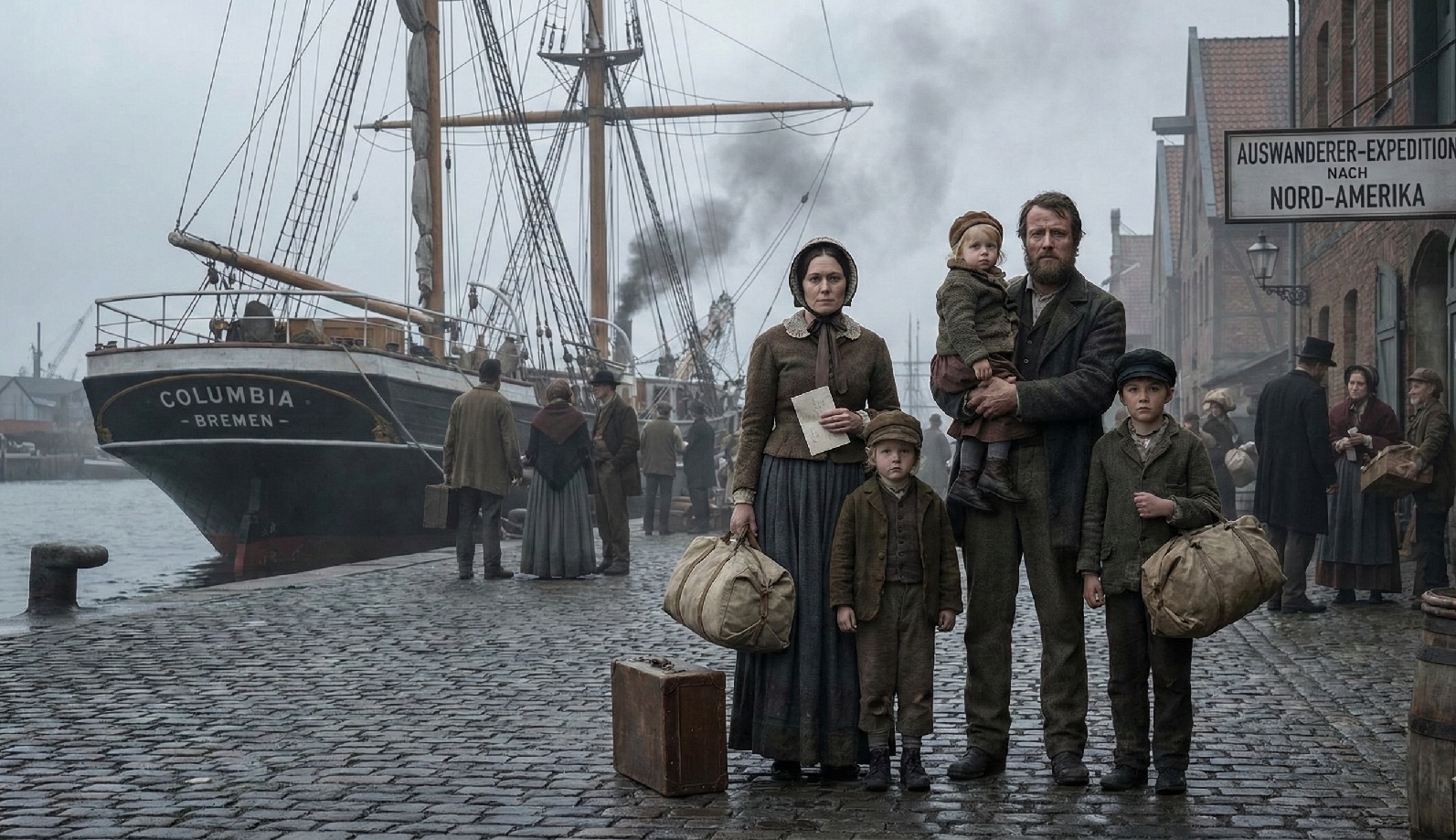
German Emigration Routes Across the Atlantic
Anyone who wanted to emigrate from the Eifel to America in the 19th century faced an enormous undertaking. Between the decision to leave home and arrival in the New World lay weeks of hardship, uncertainty, and danger. The journey proceeded in several stages – each with its own challenges.
For the Nisius families from the villages of the Bernkastel-Wittlich district, this journey began on the same paths they had known for generations: the trails down to the Moselle. But this time the destination was not the market in Wittlich or Trier – but a continent on the other side of the ocean.
Stage 1: From the Eifel to the Rhine
The first hurdle was the journey from the remote Eifel villages to one of the major rivers. Most emigrants from the region used the Moselle to reach the Rhine. From places like Platten, Osann, or Monzel, they first traveled on foot or by ox cart to the nearest Moselle port – often Bernkastel, Traben-Trarbach, or Cochem.
From there, flat Moselle barges traveled downstream to Koblenz, where the Moselle flows into the Rhine. The journey took one to two days and cost little – the river carried the boats with the current. Going upstream was a different matter: expensive and laborious, which made return unthinkable for many.
Emigration Routes: From the Eifel to America
The journeys of the Nisius families to the overseas ports (1840–1900)
Legend
Explore Routes
Click on locations on the map to learn more. Or select a typical emigrant route:
Once on the Rhine, the journey continued northward. Emigrants traveled on Rhine vessels – initially sailing barges, and increasingly on steamships from the 1830s onward – to Cologne or further to the Netherlands. From Cologne, there were also land connections by stagecoach and later by railroad to the North Sea ports.
Stage 2: German Emigration Ports: Bremen, Antwerp, Le Havre
Depending on the decade, budget, and availability of ship passages, Eifel emigrants chose different ports:
Antwerp (Belgium)
For many emigrants from the Rhineland, Antwerp was the nearest major overseas port. The city lay only a few days’ journey from the Rhine and was accessible via well-maintained roads and later the railroad. Numerous emigration agencies advertised the route via Antwerp in German villages. The Red Star Line and other shipping companies offered regular crossings to New York and Baltimore.
Le Havre (France)
The French port of Le Havre was particularly important in the first half of the 19th century. The connection via Paris was well established, and many ships sailed from here to New Orleans – a destination attractive to emigrants heading for the Southern states or the Mississippi Valley.
Bremen and Bremerhaven (Germany)
The Bremen ports developed into Germany’s most important emigration gateway from the 1830s onward. Bremen recognized the business potential early and built its own deep-water port in Bremerhaven in 1827. Strict regulations were intended to protect emigrants from the worst abuses of the trade – a reputation that made Bremen popular with reputable agencies and emigrants alike.
Rotterdam (Netherlands)
Rotterdam also played a role, especially for emigrants coming via the Lower Rhine. The Holland-America Line offered regular connections to New York from 1873.
Stage 3: The Atlantic Crossing
Crossing the Atlantic was the most dangerous and unpredictable part of the journey. Conditions on board, the duration of the crossing, and survival chances depended heavily on when one traveled and how much one could pay.
The Sailing Ship Era (until ca. 1860)
In the early period of mass emigration, most emigrants traveled on sailing ships. The crossing lasted – depending on wind and weather – six to twelve weeks. Passengers traveled in steerage, a dark, stuffy space below the main deck where hundreds of people were crammed together in the tightest quarters.
Conditions were miserable: little fresh air, contaminated drinking water, spoiled food. Diseases spread quickly – typhus, cholera, dysentery, and scarlet fever claimed dozens of victims on some crossings. Particularly feared were the “coffin ships,” on which mortality rates reached up to 30 percent.
The Steamship Era (from ca. 1850)
With the introduction of steam navigation, conditions gradually improved. The crossing shortened to ten to fourteen days, ships were larger and more stable, and provisions became more reliable. Nevertheless, steerage remained a place of crowding and misery – only those who could afford a cabin traveled in relative comfort.
The major shipping lines – Hamburg-Amerika-Linie (HAPAG), Norddeutscher Lloyd, Cunard, White Star – competed for the millions of emigrants leaving Europe each year. This competition led to falling prices and gradually better conditions.
What the Crossing Cost
Costs varied greatly by period, shipping line, and travel class:
| Period | Ship Type | Duration | Price (approx.) |
|---|---|---|---|
| 1840s | Sailing ship | 6–10 weeks | 30–40 Taler |
| 1860s | Steamship | 14–21 days | 40–60 Taler |
| 1880s | Steamship | 10–14 days | 80–120 Mark |
| 1900s | Express steamer | 7–10 days | 150–200 Mark |
For comparison: A day laborer in the Eifel earned about 15–20 Taler per year around 1850. The crossing thus cost two to three years’ income – a fortune that was often raised by selling all possessions, years of savings, or support from relatives who had already emigrated.
Stage 4: Arrival in America
After weeks at sea, emigrants finally reached the American coast. The most important arrival ports were:
New York: Castle Garden and Ellis Island
New York was by far the most important immigration port. Until 1855, there was no central registration – ships simply docked at Manhattan’s piers, and passengers streamed into the city. The chaos and exploitation by unscrupulous agents led to the opening of Castle Garden in 1855, the first official immigration station.
In 1892, Castle Garden was replaced by Ellis Island, which remained the main gateway for millions of immigrants until 1954. Here arrivals were registered, medically examined, and – in a few cases – rejected. For most, Ellis Island was the gateway to a new life.
Baltimore
Baltimore was the second most important immigration port on the East Coast and particularly attractive for emigrants heading inland. From here, the Baltimore & Ohio Railroad led directly west – a faster and cheaper connection than via New York.
New Orleans
Via New Orleans came mainly emigrants destined for the Southern states or the Mississippi Valley. From here, one could travel by steamboat up the Mississippi to St. Louis and further into the Midwest.
Stage 5: German Immigration to Wisconsin
For the Nisius families, the destination was usually Wisconsin. The state had developed into a center of German immigration since the 1840s. The reasons were manifold: inexpensive farmland, a climate similar to the German highlands, and – not least – the already established German communities where one could maintain language and culture.
From New York, the route led first by railroad or canal boat to Buffalo on Lake Erie. From there, steamships crossed the Great Lakes – Erie, Huron, Michigan – to Milwaukee or Sheboygan. This final stage took several more days but offered almost comfortable conditions compared to the Atlantic crossing.
Once in Wisconsin, many families moved further into the countryside, where the government and private companies offered farmland on favorable terms. German settlers concentrated particularly in the counties around Milwaukee, in the so-called “German Belt” from Ozaukee to Dodge County.
Nisius Family Emigrants: Passenger Lists & Records
Passenger lists and census data allow us to trace the journeys of individual Nisius emigrants:
Johann Peter Nisius (1832–1898)
Johann Peter left his home village in 1854 – in the midst of the great emigration wave following the failure of the 1848 revolution. Passenger lists show him aboard the Helena Sloman, which departed Bremen on March 15, 1854, and arrived in New York on April 28. The crossing took 44 days.
In the 1860 census, Johann Peter appears as a farmer in Washington County, Wisconsin. He had married, owned 80 acres of land, and lived in a community where almost all neighbors came from German lands.
The Matthias Nisius Family (Emigration 1867)
Matthias Nisius emigrated with his wife Catharina and three children. The family traveled via Antwerp and reached New York on June 12, 1867, aboard the Rhein. Unlike the early emigrants, the family already benefited from steam navigation – the crossing took only 16 days.
The family settled in Ozaukee County, where Matthias initially worked as a farm laborer and later as an independent farmer. Three more children were born in Wisconsin.
The Nisius Emigrations Timeline
Margaretha Nisius (1845–1919) – A Single Woman
Unusually for her time, Margaretha Nisius emigrated alone in 1871. The reasons are not recorded – perhaps she followed relatives who had already emigrated, perhaps she was widowed or unmarried. Passenger lists record her as “single” aboard the Westphalia, which sailed from Hamburg to New York.
In Wisconsin, Margaretha married a German-American farmer and lived near Cedarburg until her death in 1919. Her gravestone in the Lutheran Cemetery still bears a German inscription today.
What Remained of the Journey
Emigration was a rupture that changed families forever. Those who left behind not only possessions but also parents, siblings, friends – people whom in most cases they would never see again. Letters crossed the Atlantic, sometimes with months of delay, sometimes not at all. News of a parent’s death often reached emigrants only weeks or months later.
And yet the connection never completely severed. Money transfers flowed back to the Eifel – sometimes enough to enable further family members to make the crossing. Historians call this phenomenon chain migration: a pioneer went ahead, established himself, and gradually drew relatives and acquaintances after him.
For the Nisius families, emigration meant the end of the Eifel story and the beginning of a new chapter. Descendants live today in Wisconsin, Minnesota, Illinois, and other states – often without knowing that their ancestors once cultivated wine in a small village on the Moselle.
Genealogy Sources: Passenger Lists & Archives
Those wishing to research their own family’s emigration history will find valuable sources in these archives and databases:
| Resource | Period | Content |
|---|---|---|
| Ellis Island | 1892–1957 | New York passenger lists |
| FamilySearch | Various | Free genealogical database |
| Landeshauptarchiv Koblenz | 19th c. | Rhineland emigration lists |
| Oldenburg Emigrant Database | 1830–1930 | Bremen/Bremerhaven lists |
Further Reading
- Life in Wisconsin – Starting anew in the New World
- The Nisius Chronicle – The complete family history
- From the Eifel to America: Routes and Fates – The journey across the Atlantic