
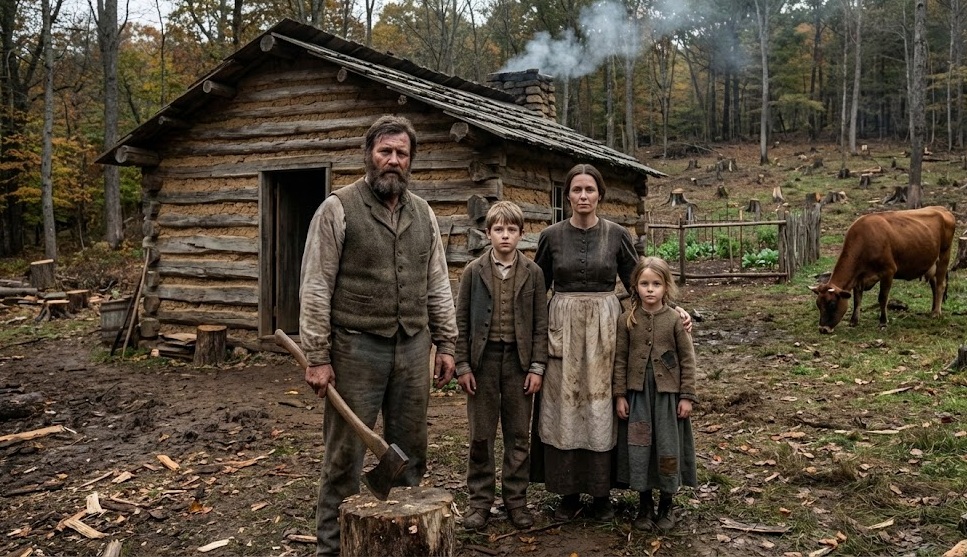
Arrival in the New World
After weeks on the Atlantic and an arduous journey through the American interior, the Nisius families finally reached their destination: Wisconsin. The state on the western shore of Lake Michigan became home to hundreds of thousands of German immigrants between 1840 and 1890. But what awaited them there? How did they live, work, and preserve their identity in the New World?
Arrival in Wisconsin was not an end but a beginning. The crossing had depleted their savings, the families were exhausted, and before them lay wilderness that had to be transformed into farmland. And yet: For most German immigrants, Wisconsin was a place of hope. Here they could achieve what had become impossible in the overcrowded Eifel – own land and offer their children a better future.
This article traces the lives of German emigrants in Wisconsin – from the hard early years of settlement to the emergence of flourishing German-American communities that still shape the state today.
Why Wisconsin? The Appeal of the Midwest
The Promise of Land Ownership
For a day laborer from the Eifel, land ownership was an unattainable dream. The small parcels of the Moselle region were divided further with each generation until they could barely support a family. Wisconsin, however, offered something unthinkable in Europe: seemingly unlimited land at affordable prices.
In the 1840s, an acre of federal land cost only about $1.25 – roughly equivalent to two Taler. For an amount that would barely have covered a few months’ rent back home, an immigrant in Wisconsin could buy enough land to start an entire farm. The Homestead Act of 1862 made the offer even more enticing: Anyone willing to work 160 acres for five years received it practically free.
These numbers spread like wildfire through the villages of the Eifel. In letters home – the so-called “America Letters” – early emigrants reported on the incredible opportunities. A single such letter, read aloud in the village tavern, could trigger dozens more emigrations.
The America Letters weren’t always entirely honest. Thus many a legend of milk and honey was born, only to land on the ground of reality upon arrival – a ground that first had to be cleared.
A Piece of Home in a Foreign Land
Wisconsin was no coincidental destination for so many German immigrants. The landscape reminded many of their homeland: gently rolling hills like the Eifel, dense forests that provided building and firewood, and fertile soils where wheat, potatoes, and vegetables thrived. The temperate climate with its four distinct seasons felt familiar – even if the winters were harsher than along the Moselle.
For immigrants from the rugged Eifel, the cold was no obstacle. They knew hard winters, they knew poor soils, and they knew how to make do with little. What they found in Wisconsin was challenging but manageable. And above all: It belonged to them.
The Power of Chain Migration
No immigrant arrived in the unknown. The Nisius families, like most German emigrants, followed the paths of relatives, neighbors, and countrymen who had gone before them. When Johann Peter Nisius arrived in Washington County in 1854, he found a small community of Moselle folk already there to help him with his first steps.
This chain migration was the key to the success of German settlement in Wisconsin. Newcomers were taken in by countrymen, provided with shelter, work, and practical advice. Established settlers often helped new arrivals with land purchases, acquiring tools, or finding work on a farm until enough money was saved for their own settlement.
The letters that went back to Europe contained not only reports of the new life but often concrete instructions: Which port to use, which route inland was best, and above all – whom to go to upon arriving in Wisconsin.
The “German Belt”: Where the Germans Settled
A Region Becomes German
German immigrants did not spread evenly across Wisconsin. They concentrated in certain regions where they soon formed the majority of the population. The so-called “German Belt” stretched in a broad band from Milwaukee in the east to La Crosse in the west, encompassing some of the state’s most fertile agricultural areas.
In some counties, the proportion of German-descended population exceeded fifty percent by 1890. Ozaukee County on the Lake Michigan shore, with about half of German descent, was one of the “most German” areas outside Europe. Washington County, where Johann Peter Nisius settled, wasn’t far behind at about 45 percent. In these regions, one could live an entire life in German – from church services to school to shopping at the German grocer.
Milwaukee itself developed into the unofficial capital of German America. The city on Lake Michigan was called “German Athens” – a center of German culture, education, and commerce. German-language newspapers were published here, Turner clubs and singing societies met here, and German immigrants brewed the beer that would make Milwaukee the “Beer Capital of the World.”
The town of Germantown was founded by settlers who apparently had no time for creative name-finding. At least everyone knew immediately what they were dealing with.
The Nisius Settlement Areas
The various branches of the Nisius family settled in three neighboring counties, all in the heart of the German Belt.
Washington County became the first home of Johann Peter Nisius, who arrived in 1854 as one of the early Nisius emigrants. The county, only about 30 miles northwest of Milwaukee, offered fertile farmland that had already been developed by earlier German settlers. The rolling hills reminded them of home, and proximity to Milwaukee provided access to markets and German infrastructure.
In Dodge County, the family of Matthias Nisius settled in 1867 with five children. This area in the heart of Wisconsin was known for its excellent conditions for dairy farming – a specialization that German immigrants with their knowledge of cheese-making and animal husbandry practiced particularly successfully.
Ozaukee County on the Lake Michigan shore became home to Nikolaus and Anna Maria Nisius in 1886. When they arrived, they found an already well-established German community with Catholic churches, German schools, and a dense network of social institutions.
The First Years: Building a Farm in the Wilderness
From Wilderness to Farmland
Arrival on one’s own land was a moment of pride – and disillusionment. What was designated as “farm” on paper was actually dense forest or overgrown brushland. Before a single grain could be sown, the land had to be cleared, work that could take years.
A strong man could make about two to three acres arable in a season – if he was lucky and not delayed by illness, accidents, or extreme weather. The trees had to be felled, stumps dug out, roots removed, and the soil plowed. Every single acre meant weeks of hard physical labor with axe, saw, and spade.
The first shelters were primitive: small log cabins of rough-hewn logs, often with only a single room where the whole family lived, ate, and slept. A fireplace or iron stove provided warmth and served for cooking. Windows were a luxury many couldn’t afford for years – initially, openings covered with oiled paper sufficed.
Such a log cabin could be built by a family in a few weeks – provided they had the necessary tools and some experience. The gaps between logs were sealed with moss and clay, the roof consisted of wooden shingles or sometimes just bark. The first winter was often bitterly cold, but it was a start.
Only after years, when the farm began producing returns and some money was left over, could a proper farmhouse of sawn boards or even stone be built. Some families lived ten years or longer in their original log cabins.
What a Settler Needed
A settler’s basic equipment was manageable but not cheap. A good axe – the most important tool for clearing – cost about two to three dollars. A plow for working the soil ran ten to fifteen dollars. Added to this were a scythe for harvest, seed for the first planting, and if possible a cow for milk and one or two pigs for meat.
All together, a family needed about fifty to one hundred dollars to finance a minimal farm establishment – in addition to the travel costs already spent. For most immigrants who had hardly any money left after the crossing, this meant: They first had to work as farmhands or maids on established farms until they had saved enough to begin their own settlement.
These first years as farm laborers were hard, but they also served as an apprenticeship. The newcomers learned American farming methods, acclimated to the weather, and made contacts that would help them later in building their own farm.
The Rhythm of the Farm Year
Life on a Wisconsin farm followed the relentless rhythm of the seasons. There were no weekends, no holidays – the animals had to be cared for every day, and field work allowed no delay.
Spring began with snowmelt, which turned the land into a muddy chaos. As soon as the ground was workable, plowing and sowing commenced – wheat, oats, barley, potatoes. Simultaneously, calves and lambs were born, demanding round-the-clock attention. Spring was a time of hope but also of exhaustion.
In summer, the hay harvest was on – backbreaking work under burning sun. The hay had to be cut, dried, and stored in the barn before rain could spoil it. Besides this, fields had to be kept free of weeds, the vegetable garden tended, and repairs made to buildings and fences.
Autumn was the busiest time of year. The grain harvest had to be brought in before the first frosts came. Potatoes were dug up and stored. Pigs were slaughtered, the meat salted and smoked to survive the winter. Every day counted, for what wasn’t completed in time couldn’t be made up.
Winter brought a different kind of work. In the short, cold days, wood was cut for the next year, tools were repaired, butter was made and sold. The women spun and wove, the men mended harness and equipment. It was the time when the family drew closest together – literally, as the kitchen was often the only heated room.
Wisconsin winters presented new challenges even for hardy Eifel folk. A popular joke among German settlers: “Wisconsin has two seasons: winter and road construction.” The punchline still works today, and anyone who’s been in Milwaukee in January knows why.
Economy and Work: From Survival to Prosperity
Wisconsin Becomes the “Dairy State”
In the first decades, German farmers focused on growing wheat – the “white gold” of the Midwest. But over time, soils deteriorated from one-sided use, and competition from the even more fertile prairie regions further west pushed prices down. The German immigrants, known for their adaptability, responded with a specialization that still defines Wisconsin today: dairy farming.
German and Swiss immigrants brought centuries-old knowledge of cheese-making. They understood how to transform milk into durable products that could be transported over long distances. Small cheese factories sprang up throughout the German Belt, often run by individual farm families. By 1900, Wisconsin had risen to become the leading cheese producer in the United States – a title the state still claims today.
The shift to dairy farming also changed the work rhythm. Cows must be milked every day, morning and evening, seven days a week. It was work that required discipline but also offered a certain security: Unlike a wheat harvest that could be destroyed by hail or drought, the cows delivered steady income year-round.
The Breweries of Milwaukee
While farmers in the countryside produced cheese, German immigrants in Milwaukee created another industry that would carry the city’s name around the world: beer brewing. Names like Pabst, Schlitz, Miller, and Blatz are still known today – all German immigrant families who made their fortune in Milwaukee.
The breweries provided jobs for thousands and shaped the city’s economic and social life. Milwaukee became the “Beer Capital of the World,” and German brewing culture permeated all aspects of city life. The big breweries sponsored Turner clubs and singing societies, financed the construction of concert halls and parks, and helped make Milwaukee a center of German culture in America.
The name “Nisius” traces back through Saint Dionysius to the Greek god of wine. That this family of all people ended up in beer country Wisconsin would probably have amused Dionysus – a party is a party.
The Occupations of the Nisius Families
The various branches of the Nisius family followed the typical pattern of German immigrants in Wisconsin. The first generation – Johann Peter, Matthias, Nikolaus, and the others – were almost exclusively farmers. They cleared land, built farms, and established their families in their new homeland.
Margaretha Nisius, who emigrated as a single young woman in 1871, initially worked as a domestic servant in Milwaukee before marrying a farmer and becoming a farmer’s wife herself. Her life path shows how even single women could gain a foothold in Wisconsin – though within the narrow social constraints of their time.
The second and third generations increasingly diversified. Some stayed on their parents’ farms or founded their own agricultural operations. Others moved to cities and became craftsmen, merchants, or civil servants. The fourth generation often entered academic professions – doctors, teachers, engineers – thus completing the ascent their great-grandparents had hoped for when they left the Eifel.
Community and Culture: The German World in Wisconsin
The Center of Life: The Parish
For German immigrants, the church parish was far more than a place of religious devotion. It was the center of social life, a piece of home in a foreign land, a place where one was among one’s own. Here sermons were delivered in German, here children were confirmed in their parents’ language, here one met countrymen from the old homeland.
The Nisius families, coming from the Catholic Moselle region, joined the Catholic parishes of their respective counties. These parishes were organized by region of origin or dialect groups – there were “Rhinelander” churches and “Bavarian” churches, and sometimes tensions between them. But for Moselle folk like the Nisius families, the Rhineland-influenced parishes offered a familiar spiritual home.
The parish registers of these congregations are invaluable sources for family research today. Kept in German, often in the handwriting of a priest from Bavaria or the Rhineland, they document baptisms, marriages, and deaths across generations. In them, the history of German immigrants can be read – and often their gradual Americanization, as increasingly English entries appear from about 1900.
In some areas, there were even separate German taverns – one for Catholics, one for Protestants. When it came to beer, apparently, there was no joking around. (The good Lord probably did find it amusing, though.)
Clubs: The Backbone of German Community
Besides the church, clubs shaped German community life in Wisconsin. The Germans brought their club culture across the Atlantic and founded organizations in every town and village that structured social life.
The Turner clubs were more than sports clubs. They pursued the ideal of “Father Jahn” – physical fitness as the foundation of a free, enlightened citizenry. Politically, they often stood on the progressive-liberal side, and during the Civil War, the Turner clubs provided a disproportionate number of soldiers for the Union Army.
The singing societies cultivated German songs and organized regular concerts and singing festivals. For many immigrants, communal singing was an emotional anchor, a connection to home. The songs they sang – folk songs from the Eifel, the Palatinate, from Bavaria – kept the memory of the old country alive.
Shooting clubs organized shooting festivals on the German model – multi-day celebrations with competitions, dancing, and plenty of beer. The mutual aid societies offered help in emergencies: When a member fell ill or died, others stepped in with money, labor, or practical help for the survivors.
The German Press: News from Two Worlds
Wisconsin had a remarkably vibrant German-language press. In Milwaukee alone, several daily newspapers appeared in German, including the influential Germania. In almost every larger town, there was at least one German-language weekly, and even small communities often had a German local paper.
These newspapers reported from two worlds: They informed about local events in Wisconsin, politics in Washington, and affairs of the German community. Simultaneously, they printed news from Germany, kept readers informed about developments in the old homeland, and maintained the connection across the Atlantic.
For many older immigrants who never properly learned English, these newspapers were the only window to the world outside their immediate surroundings. For the younger generation growing up bilingual, they were a means of maintaining the German language and preserving the connection to their heritage culture.
The Nisius Emigrations Timeline
Daily Life and Family: Living on the German Farm
The Farmhouse as Center of Life
The typical German farmhouse in Wisconsin followed patterns the immigrants knew from their homeland and adapted to new conditions. At the center stood the large kitchen with its cast-iron stove – here food was cooked, meals eaten, work done, and life lived. In winter, the kitchen was often the only truly warm room, and the family spent the long evenings here.
The “good parlor” – called gute Stube in German even in Wisconsin – was reserved for special occasions: visits, holidays, family celebrations. It was only heated when guests came and was furnished with the best furniture and mementos from the old homeland. Here hung the family photos, here stood the family Bible, here important conversations were held.
Upstairs, the children slept, often several to a room. Space was scarce, privacy a luxury that farm families couldn’t afford. The outbuildings – barn, smokehouse, milk cellar, outhouse – completed the farmstead and were as important for daily life as the house itself.
Eating Like Home
German cuisine survived the Atlantic and was preserved and developed in Wisconsin. Sauerkraut, the most important winter vegetable, was made on every German farm – the sour smell in autumn when the kraut barrels were filled belonged to the yearly rhythm. Potato dishes in all variations, pork and sausages, heavy sourdough bread, and of course beer defined the menu.
At the same time, German immigrants adopted new ingredients unknown in the old homeland. Corn became cornbread, turkey came to the holiday table, maple syrup sweetened breakfast, and pumpkin found its way into German cuisine. This blending of old and new world created a distinctive German-American cuisine that remains alive in Wisconsin today.
At Milwaukee Brewers baseball games, the sixth-inning break features the “Sausage Race” – a competition between mascots shaped like Bratwurst, Polish Sausage, Italian Sausage, Hot Dog, and Chorizo. The Bratwurst – the German heritage – wins suspiciously often. Whether that’s coincidence or local patriotism remains to be seen.
Festivals and Holidays: Time Stands Still
The hard daily routine was interrupted by festivals that marked the year’s cycle and brought the community together. Christmas was celebrated in German tradition – with a decorated Christmas tree, a custom German immigrants brought to America and that spread from here across the country. Children received their gifts on Christmas Eve, not on the morning of December 25th like the “Yankees.”
Weddings were multi-day affairs to which the whole neighborhood was invited. People ate, drank, and danced – traditional folk dances from home, later also American dances. The fall butchering, when pigs were slaughtered, was work and celebration at once: Neighbors helped with the heavy work and were rewarded with fresh sausage and other delicacies.
At the same time, German immigrants adopted American traditions. July 4th, American Independence Day, was celebrated with fireworks and feasting – a demonstration of belonging to the new homeland without giving up the old.
Integration and Identity: Between Two Worlds
The First Generation: German in America
For the immigrants themselves – Johann Peter, Matthias, Nikolaus, and the other Nisius – Germany remained home, even though they never returned. They spoke German, thought in German, dreamed in German. They learned English only as much as necessary for daily survival – for business with American traders, for official dealings, for communication outside the German community.
Their identity was clearly defined: They were Germans living in America. American citizenship, which they acquired, was a practical tool, not a declaration. It enabled land purchase and voting rights but changed nothing about who they were inside.
The Second Generation: Between Worlds
The children of immigrants born in Wisconsin grew up in two worlds. At home they spoke German with their parents, at school they learned English, on the playground they mixed both. They were bilingual and bicultural – able to move in both worlds, fully at home in neither.
This generation identified as “German-American”: German heritage, American future. They preserved their parents’ traditions but adapted them to the new environment. They attended the German church but also the American county fair. They ate sauerkraut but also apple pie.
The English of the second generation was often marked by charming quirks. Anyone who said “once” as “einmal” or parked verbs at sentence end immediately outed themselves as a child of German parents – “Wisconsin German,” so to speak, a language unto itself.
The Third Generation and World War I
The grandchildren of immigrants already grew up with English as their dominant language. German was the language of grandparents, no longer the language of daily life. They still understood it but rarely spoke it. Their identity was “American with German background” – German was heritage, not present.
America’s entry into World War I in 1917 marked a dramatic turning point. Practically overnight, everything German became suspect. German-language schools were closed, German newspapers shut down, streets and place names “Americanized.” Speaking German in public risked hostility or worse. Sauerkraut was renamed “liberty cabbage,” German music banned from concert halls.
Many families, including the Nisius descendants, gave up the German language in public life during this time. What had been built over three generations – a flourishing German-American culture – was destroyed in a few years. The fourth generation grew up monolingual in English, German only a distant memory.
The renaming frenzy of World War I produced strange blossoms. “Sauerkraut” became “liberty cabbage,” “hamburger” became “liberty steak,” and German Shepherds mutated into “American Alsatians.” The name “Nisius” was fortunately spared – perhaps it was too unpronounceable to be dangerous to the patriots.
The Legacy Today: Traces of German Immigrants
Visible Signs
Even today, more than a hundred years after the end of the great immigration wave, German heritage is omnipresent in Wisconsin. Place names like Berlin, New Berlin, Germantown, Kiel, or Stuttgart recall the founders’ origins. German half-timbered houses and stone churches define the architecture of some communities. The breweries, though many bought out or closed, have left a tradition that lives on in Wisconsin’s vibrant craft beer scene.
German Fest in Milwaukee, held every year in late July, is the largest German festival in North America. Hundreds of thousands of visitors come to enjoy bratwurst and beer, hear folk music, and watch Schuhplattler dancing – a celebration of German culture attended by descendants of immigrants and curious “Yankees” alike.
On the Trail of Ancestors
For descendants like the far-flung Nisius family, Wisconsin offers rich opportunities for tracing roots. The Wisconsin Historical Society in Madison preserves church records, newspapers, and photographs from the German immigrant era. The County Courthouses in Washington, Dodge, and Ozaukee County contain land deeds, wills, and other documents that chronicle ancestors’ lives.
Online databases like FamilySearch and Ancestry have digitized and made accessible millions of documents. US Census entries show where the family lived, how large it was, what occupations were practiced. Passenger lists document arrival in America. Cemetery records – many written in German – testify to the end of a life’s journey.
The genealogy of the Nisius family is part of this larger history. Every entry in a church book, every signature on a land document, every name on a gravestone tells of people who left everything behind to start anew – and who made Wisconsin what it is today.
Summary
The lives of German immigrants in Wisconsin were marked by hard work and great hopes. The Nisius families and hundreds of thousands of others left the Eifel, the Rhineland, Bavaria, and other regions to start anew in the American wilderness. They cleared forests, built farms, founded churches and clubs, preserved their culture while integrating into their new homeland.
Over four generations, identity transformed from “Germans in America” to “Americans with German heritage.” World War I dramatically accelerated this process, but it couldn’t erase the heritage. To this day, German immigrants shape Wisconsin – in agriculture, in cuisine, in place names and family names, in a mentality that combines hard work and community spirit.
The history of the Nisius family is a window into this larger story. It shows what millions of German emigrants experienced: the departure from home, the dangerous crossing, the hard early years, the slow rise to modest prosperity, the balance between preservation and adaptation, and finally the merging into a new American identity – without entirely forgetting the old.
Anyone meeting a “Nisius” in Wisconsin today can assume that somewhere in the ancestry lies a journey: From the vineyards of the Moselle through the streets of Antwerp or Bremen, across the stormy Atlantic and the canals of the Great Lakes to the gentle hills of Wisconsin. The name survived the journey – even if the wine god Dionysus, from whom it derives, has willy-nilly become a beer drinker in the land of breweries.
Further Reading
- From the Eifel to America – The transatlantic crossing
- The Nisius Chronicle – The complete family history
- From the Eifel to America: Routes and Fates – The journey across the Atlantic
Sources and Further Information
The Wisconsin Historical Society in Madison is the central resource for researching German immigration to Wisconsin. Their extensive archives contain church records, newspapers, photographs, and personal documents from the immigrant era. Online at wisconsinhistory.org.
FamilySearch offers free access to digitized church records and other genealogical sources from Wisconsin. Particularly valuable are the collections of Catholic and Lutheran congregations where many German immigrants were registered: familysearch.org
Kathleen Neils Conzen’s standard work Immigrant Milwaukee, 1836–1860 analyzes German immigration to Milwaukee and its effects on urban development. Richard Sisson’s The American Midwest: An Interpretive Encyclopedia provides broader context for German settlement in the Midwest.