
From vineyard to office, from Eifel farm to Wisconsin homestead – and what became of those who stayed behind
If you truly want to understand a family’s history, you need to ask a simple question: What did they do for a living? Nothing shapes life as profoundly as daily work. It determines where you live, whom you marry, what you eat – and what stories you tell your children.
The occupational history of the Nisius families is far from dry statistics. It’s a mirror reflecting the great historical upheavals: from the agrarian world of the Ancien Régime through industrialization to the great emigration wave. And it contains – how could it be otherwise with our name – some surprising twists.
But this story has two strands. Around 1850, the family tree split: one part dared to leap across the Atlantic. The other part stayed home. Both paths led through revolutions, world wars, and economic miracles – just in completely different worlds. This is the story of both.
Part I: Common Roots – The Eifel Years (1600–1850)
Farmers, Vintners, Craftsmen: The Trinity of the Rural Economy
Anyone leafing through the church registers of Adenau, Schuld, Leimbach, or the villages of the Ahr Valley will find a familiar pattern in our ancestors’ occupational records. The overwhelming majority of Nisius men worked in one of three categories:
1. Farmers and Agriculturalists
The Eifel was – and is – no gentle landscape for the idle. The soil is poor, the winters long, the summers short. Our ancestors worked small farms, often barely more than a few acres. They grew what the volcanic earth would yield: oats, rye, potatoes (after their introduction in the 18th century), and they kept livestock – primarily cattle and pigs.
A typical entry in a church register might read: “Johann Nisius, Ackerer of Leimbach” – where “Ackerer” was the regional term for a smallholder who worked his own land, as opposed to a “landowner” or “tenant farmer.”
2. Vintners of the Ahr and Moselle
This is where it gets particularly interesting for us. If our name truly derives from the wine god Dionysus – what could be more fitting than that many of our ancestors were vintners?
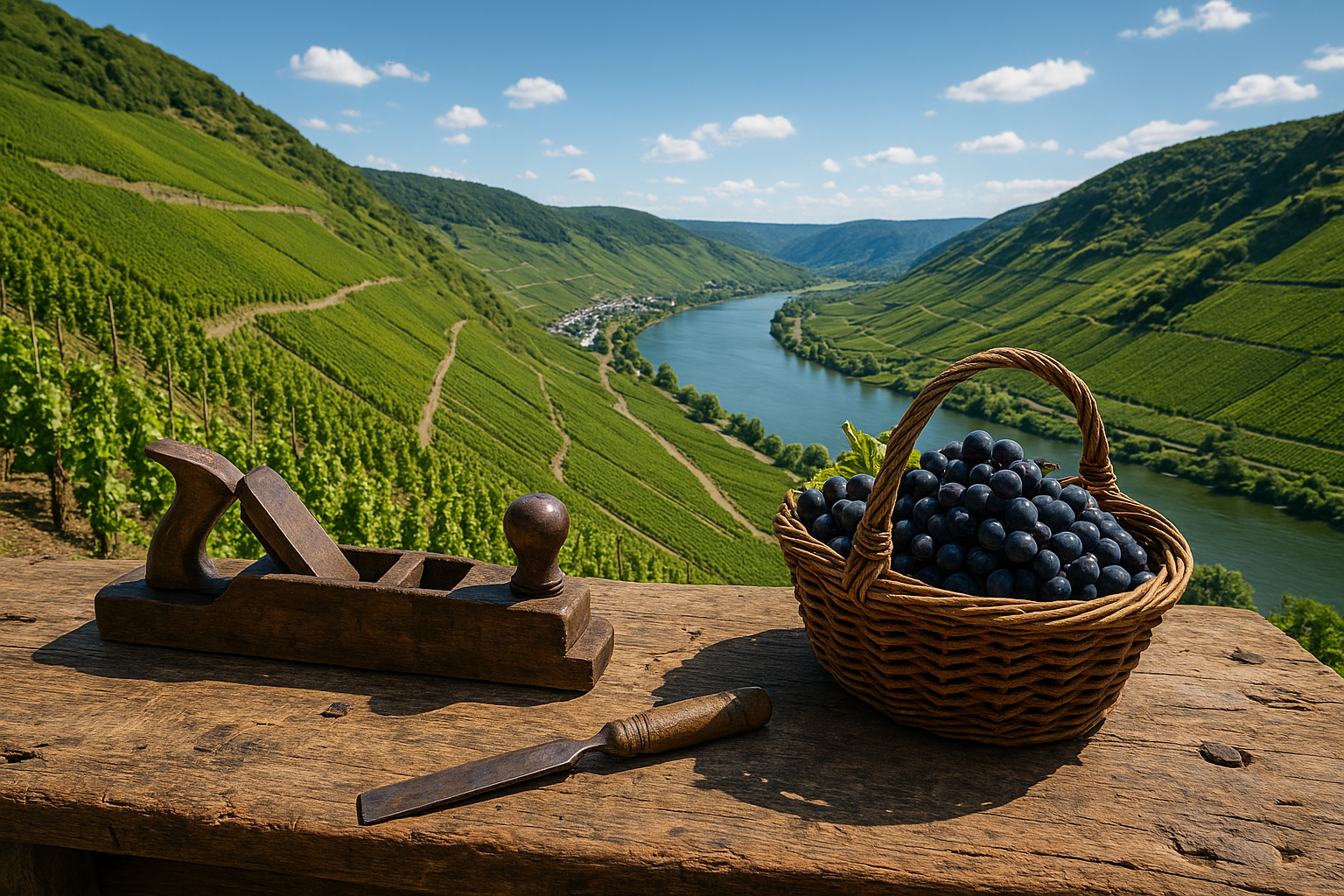
The Ahr, just a stone’s throw from the Nisius heartlands, is one of the northernmost red wine regions in the world. Viticulture on the steep slate slopes was – and is – backbreaking work. Every grape had to be picked by hand, every vine individually tended. But it also offered something that meager farming could not: cash.
In an economy largely based on barter, the vintner was the one who could sell his product at the markets in Ahrweiler or Bonn for hard currency. This didn’t make him rich, but it gave him a certain prosperity – and social standing.
The Spätburgunder (Pinot Noir) from the Ahr was already considered one of Germany’s finest in the 19th century. If your ancestors were among the vintners, they may have harvested grapes whose distant descendants now sell for 50 euros a bottle. Unfortunately, they don’t benefit from that anymore.
3. The Craftsmen: Coopers, Blacksmiths, Wheelwrights
Every agricultural community needs craftsmen. And here appears a trade that’s almost poetic for our family history: the cooper (also called barrel maker or “Küfer” in German).
The cooper made wooden barrels – those vessels in which wine was stored and transported. In a wine-growing region, he was indispensable. And so another circle closes: the Nisius families, named after the god of wine, not only worked in the vineyard but also in the workshops that created the vessel for the wine.
Beyond that, we find the usual suspects in the church registers: blacksmiths (who made horseshoes and tools), wheelwrights (who built carts and wheels), carpenters, masons – the full palette of pre-industrial craftsmanship.
The Occupational Pyramid of the Eifel
The Women: The Invisible Half of Family History
Here we must pause for a moment. When we speak of “occupations,” we speak – at least until the 20th century – almost exclusively of men. Church registers typically record no occupation for women, only their status: “wife of…”, “daughter of…”, “widow of…”.
This doesn’t mean, of course, that the Nisius women didn’t work. On the contrary: they probably worked harder than the men. They ran the household, cared for the children (often five, six, seven, or more), helped with the harvest, fed the livestock, spun wool, wove fabric, cooked, baked, preserved food for winter.
This work simply wasn’t considered an “occupation.” It was just what women did – invisible, unpaid, indispensable.
Next time you look at your family tree, consider: for every man with a recorded occupation, there was a woman whose life’s work appears in no document. She’s still there – in every generation, in every line. None of us would be here without her.
Special Cases: The Upwardly Mobile and the Clergy
Not all Nisius stayed on the farm. The church registers and matriculation records also show evidence of social mobility:
Teachers and Schoolmasters
The village schoolmaster’s profession was one of the few ways in the 19th century to escape the social constraints of peasant life – without having to leave the village. The schoolmaster was notoriously poorly paid (often he had to work on the side as sexton or organist), but he enjoyed respect. He could read and write, he knew the world beyond the church steeple – at least from books.
Clergy
In a Catholic region like the Eifel, entering holy orders was one of the few opportunities for talented farmers’ sons to obtain an education and rise socially. Whether there were Nisius priests or monks would be worth researching in its own right. The probability is high – in almost every larger Catholic family, there’s a clergyman somewhere.
Part II: The Fork in the Road (~1850)
Why Some Left – and Others Stayed
Around 1850, the Nisius family stood at a crossroads. The Eifel suffered from chronic overpopulation relative to available resources. Inheritance law required dividing property among all sons (partible inheritance) – with the result that farms grew smaller from generation to generation. Eventually, the land was simply too small to feed a family.
Added to this were the crop failures of the 1840s, particularly the potato blight (the same one that caused the Great Famine in Ireland), Prussian military conscription (three years of service for the king, far from home), and the Kulturkampf under Bismarck, which turned the Catholic population of the Rhineland against the Protestant state.
Some families decided to leave. Others stayed – out of attachment to their homeland, lack of money for the passage, fear of the unknown, or because they inherited the eldest son’s farm and had a livelihood.
The emigration was not a mass exodus. An estimated 10–20% of Nisius families emigrated. The majority stayed. But from this moment on, two parallel histories developed – with completely different working worlds.
Part III: The Germany Strand (1850–Present) 🇩🇪
The story of those who stayed
Phase 1: Times of Upheaval (1850–1871)
While part of the family sailed across the Atlantic, those who stayed behind witnessed the founding of the German Empire. Occupations remained the familiar ones: farmers, vintners, craftsmen. But the world was beginning to change.
The railroad reached the Rhineland. Suddenly, wine and agricultural products could be transported to the growing cities. The market grew larger – but so did the competition.
Phase 2: Empire and Industrialization (1871–1918)
With the founding of the Reich began the great era of German industry. And although the Eifel itself didn’t become an industrial region, the Nisius families felt the change too:
New occupations emerged:
- Railroad workers: The Ahr Valley Railway (1880) brought jobs
- Miners: The nearby lignite fields beckoned
- Factory workers: Those who moved to the cities found work in textile and metal plants
Old occupations disappeared:
- The cooper declined in importance as glass and metal replaced wooden barrels
- The weaver was displaced by the factory
- Many small farmers gave up – their farms were too small to compete with industrial agriculture
World War I (1914–1918) tore an entire generation from their occupations. Those who returned were often no longer the same. The church registers of this period record a shocking number of “fallen at…” and “missing since…”.
Phase 3: Between the Wars (1918–1945)
The Weimar Republic brought economic turbulence: hyperinflation (1923), then a brief bloom, then the Great Depression (1929). The Nisius families in Germany adapted:
Diversification of occupations:
- Some rose into the civil service (postal workers, teachers, administrative employees)
- Retail offered opportunities in small towns
- Agriculture became more modern – those who could afford it mechanized
World War II (1939–1945) was more devastating for Germany than the First. The Eifel became a combat zone twice: in 1944 during the Allied advance and in 1944/45 during the Battle of the Bulge. Many villages lay in ruins. The survivors faced nothing.
Phase 4: Economic Miracle (1950–1980)
From the rubble arose the German economic miracle. For the Nisius families, this meant:
Advancement through education:
- The children of farmers and craftsmen attended secondary schools
- Engineers, technicians, merchants – the new generation took up occupations their grandparents couldn’t even have imagined
- Women entered the workforce in greater numbers for the first time – as secretaries, saleswomen, teachers
Agriculture transformed:
- Dairy farming became more important than crop farming in the Eifel
- Farms were consolidated – larger, more efficient, but also fewer in number
- The part-time farmer emerged: mornings at the office, evenings in the barn
The Marliesenhof in the Eifel, still operated by Nisius descendants today, shows how modern agriculture and tradition can coexist. The name remains, the methods evolve.
Phase 5: Modern Germany (1980–Present)
Today, the Nisius in Germany are part of the broad middle class. Their occupations reflect the full spectrum of modern society:
- Academics: Doctors, lawyers, scientists
- Technical professions: Engineers, IT specialists, technicians
- Service sector: Bank clerks, insurance brokers, consultants
- Trades: Yes, they still exist – Nisius craftsmen who practice their trade with pride
- Agriculture: A few farms are still operated, often part-time or as organic operations
The Eifel itself has transformed: from a poor emigration region to a sought-after recreational area. The steep vineyards on the Ahr where our ancestors toiled are now tourist attractions.
Part IV: The America Strand (1850–Present) 🇺🇸
The story of those who left
Phase 1: The Great Crossing (1840–1890)
Emigration was no vacation. It was a farewell forever.
The typical route led from the Eifel via the Rhine to Rotterdam, Antwerp, Le Havre, or Bremen – the great emigration ports. From there, sailing ships (later steamers) crossed the Atlantic to New York or Baltimore. The crossing took anywhere from six weeks to three months depending on the weather.
Conditions in steerage were notorious: cramped, dark, stuffy, plagued by seasickness and occasionally by disease. Those who arrived were relieved, exhausted – and probably poorer than when they departed, for the passage often consumed their entire savings.
Passage in steerage cost around 30 to 40 dollars in 1880 – roughly equivalent to a farm laborer’s annual wage. Some families literally had to sell everything they owned to afford the tickets.
Phase 2: Wisconsin – The New Rhineland (1860–1920)
Why Wisconsin of all places? The answer is simple: chain migration.
The first German immigrants who settled in the Midwest in the 1840s wrote letters home. They reported fertile land practically being given away (the Homestead Act of 1862 offered 160 acres – about 65 hectares – to anyone willing to work the land). They reported German communities with their own churches, schools, newspapers, and – not to be forgotten – breweries.
These letters were read aloud in the villages of the Eifel, copied, passed around. They awakened hopes. And they triggered an avalanche: first one went, then he brought his brother, the brother brought his brother-in-law, the brother-in-law brought the cousins…
By 1880, according to the US Census, about 75% of all Nisius families in the USA lived in the state of Wisconsin. That’s not dispersal – that’s a colony.
The occupations: Essentially the same as before – farmers. They bought or leased land in rural Wisconsin counties – Dodge County, Jefferson County, Fond du Lac County – and began to realize the American dream.
The difference from the Eifel was enormous: instead of a few barren acres of volcanic soil, they now worked vast, flat fields of fertile black earth. Instead of rye and potatoes, they grew wheat, corn, and barley. Instead of a few cows, they kept dozens.
In some Wisconsin counties, more German than English was spoken well into the early 20th century. Church services were in German, newspapers were in German, schools taught in German. Only World War I – with its anti-German sentiment – ended this era. Sauerkraut suddenly became “Liberty Cabbage,” and speaking German became a question of loyalty.
Phase 3: Cities and Industry (1890–1950)
With the second and third generation came diversification. The farmers’ children spoke English, went to school, grew up in a country that (at least officially) knew no class barriers.
New career paths:
- Craftsmen and skilled workers: Industries arose in Milwaukee, Chicago, Minneapolis. The farmers’ sons became carpenters, mechanics, railroad workers, brewers (of course!), factory workers
- Merchants: General stores, smithies, mills – retail was a typical path upward
- White collar: Accountants, bank clerks, insurance agents, teachers
Phase 4: The American Dream (1940–1980)
A statistical outlier: The accountants of 1940
When reviewing US Census data, one encounters a curiosity: in 1940, a striking number of women with the surname Nisius were employed as accountants. Was this coincidence? A family network that helped young women enter this profession? Whatever the explanation – it’s a sign that Nisius women in America were beginning to forge their own paths.
If you belong to this generation or have information about Nisius women in the 1930s and 1940s – let us know! Every detail helps.
The postwar era was the great age of American advancement. The Nisius families became part of the broad middle class: home ownership in the suburbs, two cars, college for the children.
Phase 5: Modern America (1980–Present)
Today, American Nisius are fully integrated. For many, their German roots are only family legend – a funny surname you have to spell out on the first day of school.
Their occupations reflect the full spectrum of American society: doctors, lawyers, engineers, teachers, entrepreneurs, artists – and probably a few farmers in Wisconsin who wonder if the land they work once belonged to a distant cousin.
Part V: The Convergence – When Paths Cross Again
DNA and Genealogy: The Digital Reunion
Something remarkable is happening in the 21st century: the two strands of the family are beginning to find each other again.
DNA tests like AncestryDNA or 23andMe have made possible something unthinkable just a generation ago: a Nisius in Wisconsin can find out with a few clicks that they’re genetically related to a Nisius in the Eifel. The emigration of 1857 suddenly becomes tangible – not as abstract history, but as a connection to a living person.
Genealogy websites like this one bring the threads together: family trees are compared, data matched, gaps filled. The Matthias Nisius who was born in Leimbach in 1854 and “went to America” in 1856 suddenly reappears as Matthew Nisius in the Wisconsin censuses. His descendants learn for the first time where their name comes from.
170 years after the fork in the road, the Nisius families are finding each other again – not physically (though that happens too), but digitally, genetically, genealogically. The question “Are we related?” suddenly has an answer.
The Occupations of the Nisius Family
What We Can Learn from Our Ancestors’ Occupations
The occupational history of a family is more than a list of jobs. It’s a story of adaptation – to new countries, new technologies, new opportunities. It’s a story of continuity – of skills and values passed down through generations. And it’s a story of hope – of people who believed their children would have it better than themselves.
But it’s also a story with two paths. The Nisius in Germany experienced Empire, world wars, division, and reunification. The Nisius in America experienced the Wild West (well, Wisconsin), two world wars from a different perspective, the American dream and its limits.
Both paths led to the same point: people like us, sitting at computers and wondering where we come from.
Next time you go to work – whether to an office, a workshop, a field, or a desk in your home office – take a moment to think of the long lines of Nisius men and women who worked before you:
- The vintners who picked grapes in the autumn rain
- The farmers who plowed the barren Eifel soil
- The emigrants who fed livestock at minus 30 in Wisconsin
- The ones who stayed and survived two world wars
- The accountants of 1940 who tallied their numbers in a man’s world
- Everyone who appears in no document but was there nonetheless
They all worked so that you could be here.
That is – despite all the Dionysus humor – no small thing.
Further Reading
- The Invisible Half – Women’s Work – The role of women
- The Nisius Chronicle – The complete family history
- The Occupations of the Nisius Families – Professional development across generations
Source note: This article is based on church register entries from the Eifel region, US Census data (1850–1940), emigrant ship passenger lists, and genealogical research by the Nisius family. Additions and corrections are welcome – contact us!