
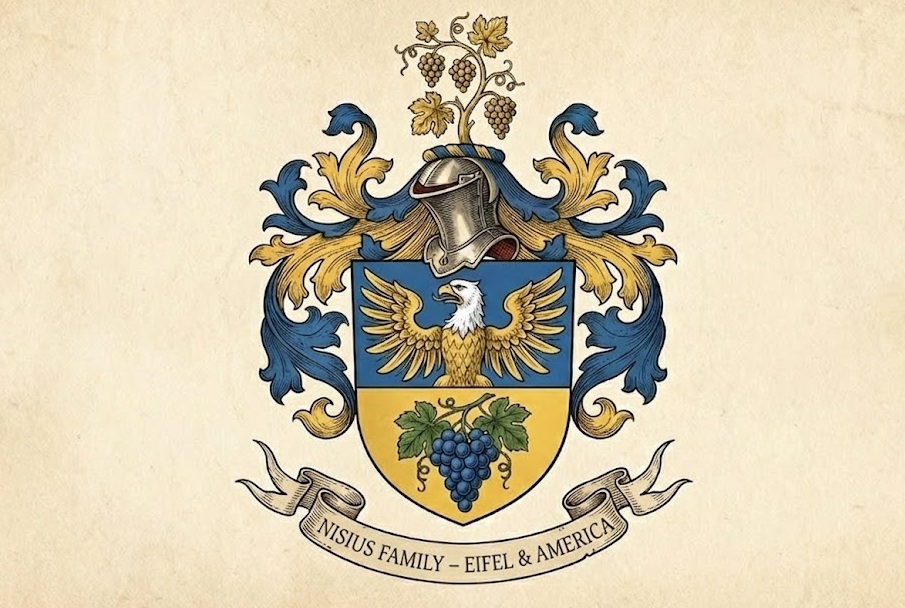
Or: Why we don’t own a castle, but still have plenty to be proud of.
If you’ve ever dug deep into our family history or spent late nights on Ancestry.com tracing the Nisius name, one exciting thought eventually crosses your mind:
Did we have a real family coat of arms?
Be honest: Who hasn’t pictured an ancestor in shining armor riding across a tournament field, the Nisius shield held high, while trumpets blare? It’s a beautiful image—a bit like Game of Thrones meets our own history. We can almost see ourselves sitting on the throne of a small county in the Eifel region.
The Reality Check: Farmers, not Feudal Lords
However, if we push the romance aside and blow the dust off the old church records from the Rhineland and the Eifel, we don’t find dukes, counts, or dragon-slayers.
We find something much more grounded—and, if we’re honest, much more impressive: We find winemakers who toiled on steep slate slopes. We find craftsmen, farmers, and the brave immigrants who left everything behind to cross the Atlantic. Our ancestors didn’t build castles or wage wars; they cultivated the land and carried their families through hard times.
The honest answer to the coat of arms question is:
No, there is no historical “noble” coat of arms for the Nisius family.
Beware of the “Family Crest” Scam
You’ve probably seen them online or at mall kiosks: “Your Family Crest – Framed and Ready!”. You type in “Nisius,” and—presto—a colorful image appears with lions, lilies, and swords.
Here is the catch: This is almost always a scam. In serious heraldry, a coat of arms never belongs to a surname generally. It belongs only to the specific individual who originally created it and their direct descendants. Even if there had been a “Knight Nisius” in the 16th century (which there wasn’t), we wouldn’t be allowed to use his arms today without proving an unbroken genealogical link.
So, please don’t buy a “fake crest” for $20. We don’t need purchased feathers to be proud of who we are.
Why We Created a Symbol Anyway
Just because we weren’t knights doesn’t mean we can’t have a shared symbol today! Since we are now a global family connected across oceans—from the Eifel region and Benelux to the United States—we took the liberty of designing a new family symbol.
It is not a historical artifact found in a dusty trunk but a modern image that tells our story.
The Language of our Arms: Colors and Symbols
A coat of arms is more than just a colorful graphic, it is a story told without words. Every element, from the choice of colors to the smallest vine, follows a centuries-old symbolic language. Here is what our family emblem actually means.
1. The Tinctures: Gold and Blue In heraldry, we don’t just speak of colors, but of “tinctures.” Our arms are dominated by the classic combination of a metal and a color: Gold (Yellow) and Blue.
- The Contrast: This choice follows the strict heraldic rule that “metal must not be placed on metal” and “color must not be placed on color.” Radiant Gold on deep Blue ensures maximum visibility—a principle dating back to medieval tournaments, so a knight could be recognized from a distance.
- The Symbolism: Blue traditionally stands for loyalty and steadfastness. In our case, it primarily symbolizes the connecting element of water: it represents the rivers (Mosel, Ahr) where our ancestors lived and simultaneously the Atlantic Ocean, which parts of the family crossed to find a new life. Gold represents not only nobility of spirit and wisdom but also light and the joy of life. It forms a warm counterpoint to the cool Blue, symbolizing the enduring value of family unity.
2. The Eagle: A Bridge Between Myth and America In the upper part of the shield, we see the Eagle. This animal was chosen for two specific reasons:
- The Mythological Origin (Nisos): The eagle is an allusion to the ancient Greek myth of King Nisos. According to legend, he transformed into a sea eagle. Since our surname is etymologically often linked to this root, the eagle serves as a “canting arms”—it visualizes the name itself.
- The Transatlantic Connection: For our relatives in the USA, the Bald Eagle is the ultimate symbol of home. By including this animal, we honor the courage of the emigrants and firmly integrate the American branch of our clan into our shared identity.
3. The Grapevine: Our Roots in the Soil and the Name The lower half of the shield and the crest atop the helmet feature a golden grapevine with blue grapes. This is the strongest symbol of our origin:
- The Homeland: Our family roots lie deep in the classic wine-growing regions of West Germany. Whether along the Ahr or the Mosel rivers, viticulture shaped the landscape and culture of our ancestors for centuries. The vine stands for down-to-earth hard work and the concept of “growth and flourishing.”
- The Name (Dionysius): One of the most likely derivations of our family name traces back to Dionysius, the ancient god of wine. The grape is thus a direct visual reference to our name’s patron.
Legal Context: From Draft to Official Family Symbol
Many people associate coats of arms with nobility or strict laws. However, the legal reality in Germany (where our name originates) is the foundation for this project.
The Principle of “Wappenfreiheit” (Right to Arms) In Germany, common law dictates that every citizen has the right to assume and display a coat of arms. You do not need a title of nobility or permission from the government. A distinct coat of arms is, legally speaking, a visual extension of the family name. Therefore, this coat of arms is a new assumption. It is based on our free will to give our family a shared identity in the 21st century.
Current Status: The “Discovery Phase” Since this coat of arms is not yet registered in an official German Roll of Arms (such as the “Herold” in Berlin), we consider the current status as a “heraldic discovery phase.” This design is our visual anchor. It is meant to be used, loved, and established in everyday life. Official registration in Germany is planned as the crowning achievement later on. However, under copyright and naming laws, this artwork is already our intellectual property.
About this Coat of Arms / Usage Rights (Disclaimer)
To ensure we all enjoy this symbol while staying on the safe side legally, the following rules apply to its usage:
1. Status of the Arms (Personal Project) The image shown here is a free, artistic design and not a historical coat of arms registered in a Roll of Arms. It was designed by me ( , 2025) as a personal project (“Liebhaberei”) to symbolically express our connection to the name Nisius. No claim to nobility or historical lineage is derived from it.
2. Invitation for Private Use (Open Source Spirit) Since Rolls of Arms often restrict the right to bear arms strictly to the direct lineage of the creator, I want to make this design available to all persons bearing the surname Nisius. You are welcome to download this graphic and use it for purely private purposes (e.g., for private letterheads, genealogy research, social media profile pictures, or decoration). Modifying the graphic is not permitted.
3. Important Exclusion: No Commercial Use Any commercial or business use (e.g., as a company logo, on products for sale, business cards for a trade, etc.) is strictly prohibited. This serves to protect the coat of arms so that it is not misused or trademarked by a third party.
4. Future Reservation Please note: I intend to have this motif professionally redesigned by a heraldist and officially registered in a German Roll of Arms in the future. The officially registered coat of arms may differ visually from this draft and may legally be reserved exclusively for my direct family line. No customary rights to the later, official coat of arms are derived from the use of this current draft.
License Notice: This work is licensed under a Creative Commons Attribution – Non-Commercial – No Derivatives 4.0 International License (CC BY-NC-ND 4.0). Author:
Our Conclusion
Wear it in your heart, print it on T-shirts for the next family reunion, or share it in the family group chat. But please, don’t frame it as an “official patent of nobility” to impress people—those who know history know the difference.
It is simply our badge of recognition for a modern family with deep roots: We are Nisius.
Further Reading
- Nisius – Surname Etymology – The history of the family name
- A King as Namesake? – The mythological connection to King Nisos
- The Nisius Chronicle – The complete family history
- The Name Nisius – Etymology and History – Where does the name come from?