
The Silence of the Sources
Anyone who searches through historical church registers and civil records encounters a recurring pattern: men have detailed occupational entries – farmer, vintner, blacksmith, day laborer. For women, silence prevails. Wife, widow, at best daughter of – the sources rarely reveal more. As if women never worked. As if their contribution to the family’s survival were invisible.
This invisibility is no accident. It reflects a social order in which women’s work was systematically not considered work. What women did – and they did much – was regarded as natural duty, not as an activity worth documenting. The consequence: half of history is missing from the historical record.
What Women Actually Worked
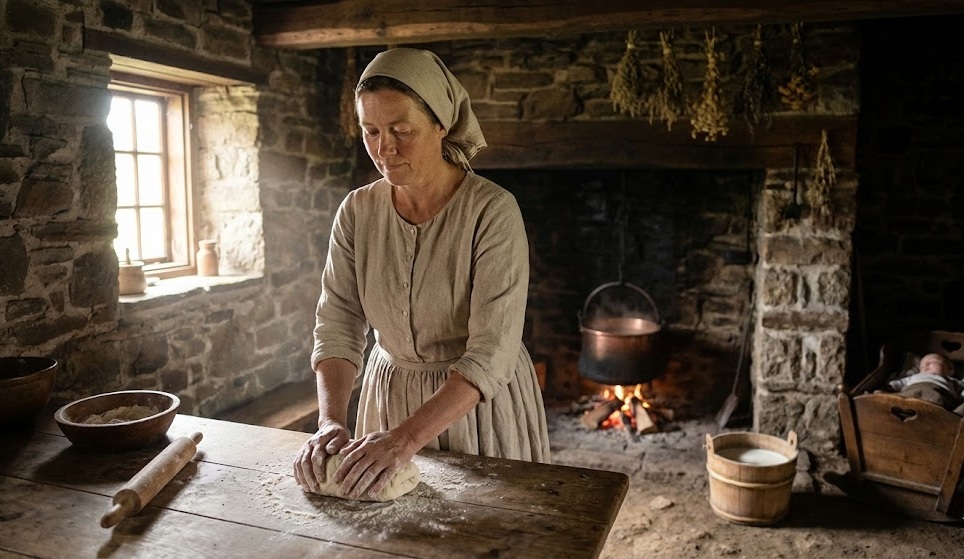
Reality in the Eifel villages of the 18th and 19th centuries looked completely different from what the sources suggest. Women were not passive housewives in the modern sense – they were indispensable workers in an economy that relied on the cooperation of all family members.
Agriculture and Viticulture
In the vintner families along the Moselle, women worked side by side with men in the steep vineyards. They helped with the harvest, tied vines, carried grapes. In the farmlands of the Eifel, they sowed and reaped, tended livestock, milked cows. This work was physically demanding and time-intensive – yet recorded as a profession in no document.
Household Production
The pre-modern household was a production unit, not a place of consumption. Women produced what the family needed to survive: they spun wool and flax, wove cloth, sewed clothing. They preserved food, brewed beer, baked bread, cooked for extended families with three generations under one roof. They made candles and soap, gathered medicinal herbs, cared for the sick.
Trade and Markets
Many women were active in small-scale trade. They sold eggs, butter, vegetables, and homemade goods at weekly markets in surrounding towns. Some ran small shops or taverns. These activities often brought the only cash income into farming households – yet they do not appear in official registers.
Wage Labor
Especially in poorer families, women additionally engaged in wage labor: as maids, washerwomen, seamstresses, day laborers. This work too is only sporadically documented, usually only when a woman was unmarried or widowed and thus appeared as an independent person.
Why the Sources Are Silent
The systematic non-documentation of women’s work had several causes:
Legal Invisibility: Married women had no independent legal personhood in pre-modern society. They were subordinate to their husbands and acted legally through them. Documents recorded the head of household – and that was the man.
Economic Definition: Work meant what brought in money or held official status. Unpaid labor in the household and on the farm did not fall into this category, despite being economically indispensable.
Tax Irrelevance: Church books and state registers served practical purposes – recording taxpayers, those eligible for military service, heirs. Women were mostly invisible in these categories.
Cultural Norms: Women’s work was considered natural destiny, not a profession. It was so self-evident that no one thought to document it.
The Nisius Women: Searching for Traces
This pattern also appears in the family history of the Nisius families. Of the more than 500 individuals recorded in the genealogy database, most women have no occupational entry. Yet traces can be found between the lines:
Anna Maria Nisius (1784–1851) is described in her death certificate as Ackersfrau (farmwoman) – one of the rare explicit occupational designations for a woman. It indicates that Anna Maria was regarded as a full working member of the farm.
Catharina Nisius (1812–1889) appears in American census data as keeping house. This formulation was common in the USA and at least made household management visible – though without recognizing it as work.
Margaretha Nisius (1756–1831) continued running the farm alone after her husband’s death and appears in later documents as widow and farmer. Only the loss of her husband made her work a matter of record.
Making Visible: A Visualization
The following infographic illustrates the extent of invisibility. It shows the proportion of individuals in the Nisius family history with and without documented occupations.
What We Learn From This
The invisibility of women’s work in historical sources is not evidence that women did not work. It is evidence of the limitations of our historical record – and a reminder to practice source criticism.
Those researching family history should not confuse the absence of information with the absence of activity. The women in our family trees worked, often harder and longer than the men. That we do not know their occupations says more about the society that produced these sources than about the women themselves.
Genealogical research can help make this invisible half of history visible – by reading between the lines, reconstructing contexts, and honoring the achievements of our female ancestors.
Further Reading
- A Social Portrait of the Nisius Families – Class and status in historical context
- The Nisius Chronicle – The complete family history
- The Occupations of the Nisius Families – Professional development across generations
Sources & Literature
- Wunder, Heide: “He is the Sun, She is the Moon”: Women in Early Modern Germany. Cambridge, MA 1998.
- Hausen, Karin: “Family and Role-Division: The Polarisation of Sexual Stereotypes in the Nineteenth Century.” In: Evans, Richard J. / Lee, W.R. (eds.): The German Family. London 1981.
- Medick, Hans: Weben und Überleben in Laichingen 1650–1900. Göttingen 1996.
- Parish registers from the district of Bernkastel-Wittlich (Diocesan Archive Trier)
This page is part of the Nisius Chronicle – a research project on the history of the Nisius family in the Eifel and America.